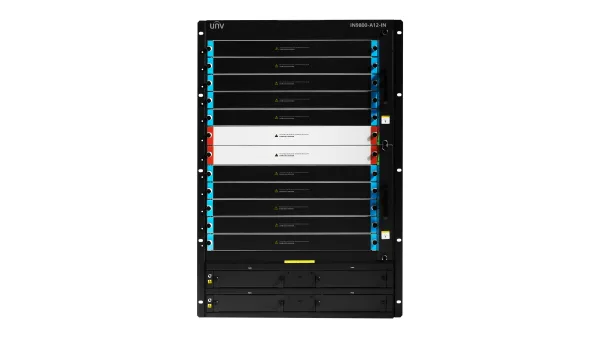
IN9800-A12-ININ9800 A12 Intelligent Switch Gateway
Equipment is sold through official dealers.
Key features
- Strong service processing capabilities. It supports perfect Layer 2 and 3 multicast protocols such as PIM SM, PIM DM, PIM SSM, MLD, and IGMP Snooping, and meets the requirements of multi-terminal HD video surveillance and video conferencing access.
- Complete security control policies. IN9800 Series supports MAC address authentication, 802.1x authentication, and PORTAL authentication, and has a built-in authentication server. It supports dynamic or static binding of user identity elements such as user accounts, IPs, MACs, VLANs, and ports, and implements dynamic delivery of user policies.
- Virtualization features. Relying on the self-developed VSM technologies, IN9800 Series can transform multiple similar service modules into "resource pools" that can be flexibly scheduled, realize the "granularization" of service platform resources, and greatly improve the resource utilization efficiency.
- Comprehensive IPV4/IPv6 dual stack. IN9800 Series hardware supports IPv4/IPv6 dual-stack and IPv6 over IPv4 tunnels (including manual tunnels, 6to4 tunnels, and ISATAP tunnels), and supports IPv6 Layer 3 line-speed forwarding, which can be used for pure IPv4 or IPv6 networks, as well as IPv4 to IPv6 coexistence networks.
- Carrier-grade high reliability. IN9800 Series supports technologies such as master control redundancy, fan redundancy, N+1 power supply, uninterrupted reboot, hot patching, and data/control/monitoring plane separation to ensure 99.999% carrier-class reliability. Fast fault detection technologies such as BFD and OAM provide a variety of device-level and network-level fault detection methods.
- Environment-friendly and energy-saving. IN9800 Series adopts a number of innovative heat dissipation technologies such as dual air duct design, and the heat dissipation efficiency is increased by 30%.
Documents
Specifications
Hardware Specification
- MPU Slots
- 2*Half-width slot
- SFU Slots
- 2
- Module Slots
- 10
- Switching capacity
- 9.6Tbps
- Forwarding performance
- 5713.92Mpps
- Fan Slots
- 2
- Cooling Fans
- 12
- Air Inlet and outlet direction
- Left and right ventilation
- Power Slots
- 4, 1 to 3 service boards, recommend 2 power supply; 4 to 8 service boards, recommend 3 power supply; 9 to 10 service boards, recommend 4 power supply.
- Power Supply
- 110V AC to 240V AC, 50/60Hz
- Max.Power
- 650W
- Dimensions (W×D×H)
- 442x480x703mm, 16U
- Operating Temperature
- 0℃ to 45℃
- Operating Humidity
- 5% to 95%, non-condensing
- MTBF
- >200000h
- Weight
- Empty Frame: ≤49.1kg Fully Loaded: ≤150kg
Software Specification
- Layer-2
- VLAN, STP, RSTP, MSTP, QinQ, flexible QinQ, VLAN Mapping, full duplex traffic control, back pressure traffic control, link aggregation (support 128 aggregation groups, with each group consisting of 8 members), cross-board link aggregation, cross-board port/flow mirroring, port broadcast/multicast/unknown unicast forwarding storm suppression, Jumbo Frame, VLAN division based on port/protocol/subnet and MAC, PVLAN, GVRP, CoS priority, etc.
- Layer-3
- IPv4: Static routing, RIP v1/2, OSPF, ISIS, BGP, policy-go-together, etc. IPv6: IPv6 static routing, RIPng, OSPFv3, ISISv6, BGP4+, transition tunnel technology from IPv4 to IPv6, etc.
- Data Center
- Support 802.1Qbg and DCB Support mainstream Overlay standards such as VXLAN Support Openflow1.3 protocol
- Virtualization
- Support VSM (Virtual Switching Matrix) N:1 virtualization technology, which performs virtualization of multiple L2 ~ 7 physical devices into a single L2 ~7 logical device. Support service chain technology, which defines business streams based on L2-7 protocol features, and allows on-demand assignment of physical/logical service modules for traffic passage. Support IP-based unified management between the host and service modules and unified configuration interface
- Reliability
- Support master control board 1+1 redundancy Support power N+1 redundancy Passive backplane design; all boards support hot-plug Support online status monitoring protocol to perform detection of key components including master control engine, backplane, chip and storage
- Multicast
- Support IGMPv1/v2/v3, IGMPv1/v2/v3 Snooping, PIM-SM/PIM-DM/PIM-SSM
- ACL
- Support ACL rules including source IP, source port, destination IP, destination port, protocol number, physical port
- Maintenance
- Support FTP, TFTP, X-modem Support Web management port, SNMP v1/v2/v3 Support RMON, NTP clock, intelligent power management
Similar models
Popular
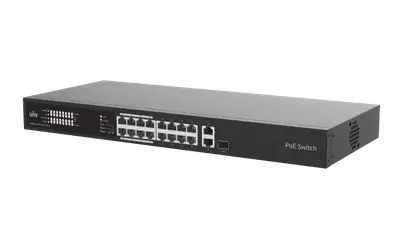
NSW2020-16T1GT1GC-LPOE-IN
Unmanaged Ethernet Switch(PoE)
Switches & Transmission
Popular
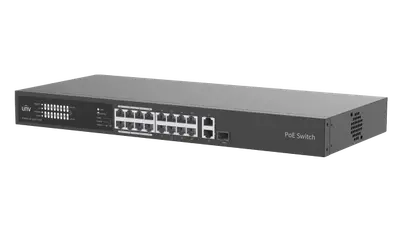
NSW2020-16T1GT1GC-POE-IN
Unmanaged Ethernet Switch(PoE)
Switches & Transmission
Popular
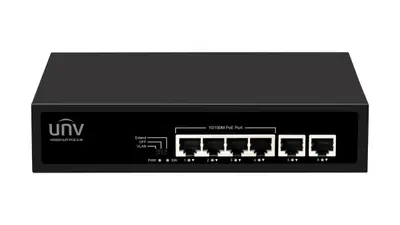
NSW2010-6T-POE-S-IN
4-Port PoE Uplink-Port 200 Megabit,PoE 60W
Switches & Transmission
Popular
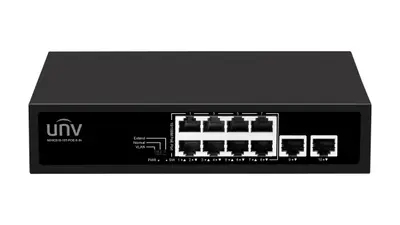
NSW2010-10T-POE-S-IN
8-Port PoE Uplink-Port 200 Megabit,PoE 96W
Switches & Transmission